
miércoles, 12 de enero de 2011

martes, 11 de enero de 2011
Acquisition and learning of a language
Today and accordimg to the material given I can resume the main differences between acquire and learn a language:
spontaneous
Acquisition: unconscious
without reflection
controlled
Learning: intentional
conscious
with a purpose
planned
is part of an evaluation
reflexive
spontaneous
Acquisition: unconscious
without reflection
controlled
Learning: intentional
conscious
with a purpose
planned
is part of an evaluation
reflexive
Contributions of Piaget´s theory to the education field
Nowadays Piaget's theory is a base for the changes made in education:
1.- He proposed "learn to learn" must be the goal of education because in this way students become in creative, independant and conscious people instead of simple tansmission and memorization of information.
2.- Piaget established that knowledge is constructed from physical and mental activities of the child:
To know an object is use it. Know it is modify it, transform it, understand
the proccess of that transformation and consequently, undestand the way it is contructed (p.8)
According to this,children need the opportunity to explore, experiment, look for answers to their questions but using the mental activity.
3.- Piaget pointed out activities must be adjusted according to the conceptual development stage of the child. Learning is better when the activities are related to things the child already know, but at the same time, it overcomes the current comprehension level in order to provoke a congnoscitive conflict.
4.- Social interaction plays an important role in the cognoscitive development to rhe child. Sociual interaction helps to reduce the egocentrism of young children.
1.- He proposed "learn to learn" must be the goal of education because in this way students become in creative, independant and conscious people instead of simple tansmission and memorization of information.
2.- Piaget established that knowledge is constructed from physical and mental activities of the child:
To know an object is use it. Know it is modify it, transform it, understand
the proccess of that transformation and consequently, undestand the way it is contructed (p.8)
According to this,children need the opportunity to explore, experiment, look for answers to their questions but using the mental activity.
3.- Piaget pointed out activities must be adjusted according to the conceptual development stage of the child. Learning is better when the activities are related to things the child already know, but at the same time, it overcomes the current comprehension level in order to provoke a congnoscitive conflict.
4.- Social interaction plays an important role in the cognoscitive development to rhe child. Sociual interaction helps to reduce the egocentrism of young children.
Approaches to teaching foreign languages
Today in the class of OPD the teacher gave us some copies about studies in the field of Teaching Foreign Languages (Piaget) , and this was what I found:
Assimilation: It involves the interpretation of events in terms of existing cognitive structure. In other words, it is to use a response already learned in order to react to a new stimulo.
Accomodation: Is the changing of the cognitive structure to make sense of the environment. In other words, it is to internalize a stimulo that does not fit in any structure we already have.
During my practice I could find this concepts like this:
Assimilation: When students repeated after me after I pronounced and pointed out the country in the map, they do it in a mechanic way (repetition and memorization). Then. they assimilated the answers to respond to the question withouth using the repetition/memorization.
Accomodation: At the moment students could distinguish some words, their function (verb, noun,etc) and the order of those elements, they accomodated that knowledge...
Finally I could notice that as secondary students are in the Formal operations stage (from 12-15 years) they involve abstractions, it means, they are more conscious and they understand what they do. And it is important to consider what Chomsky says: "Context is crucial when learning a second language", so we as teacher must create that context in the classroom.
Assimilation: It involves the interpretation of events in terms of existing cognitive structure. In other words, it is to use a response already learned in order to react to a new stimulo.
Accomodation: Is the changing of the cognitive structure to make sense of the environment. In other words, it is to internalize a stimulo that does not fit in any structure we already have.
During my practice I could find this concepts like this:
Assimilation: When students repeated after me after I pronounced and pointed out the country in the map, they do it in a mechanic way (repetition and memorization). Then. they assimilated the answers to respond to the question withouth using the repetition/memorization.
Accomodation: At the moment students could distinguish some words, their function (verb, noun,etc) and the order of those elements, they accomodated that knowledge...
Finally I could notice that as secondary students are in the Formal operations stage (from 12-15 years) they involve abstractions, it means, they are more conscious and they understand what they do. And it is important to consider what Chomsky says: "Context is crucial when learning a second language", so we as teacher must create that context in the classroom.
viernes, 12 de noviembre de 2010
Photos:First practice

Here it is shown the text used (Authentic text)

Students listen carefully to the pronunciation

Students infer the meaning of the sentences, they were mentioning some nationalities they could identify in the previous text.


Each slide had a picture which helped them to link the written information with its meaning.
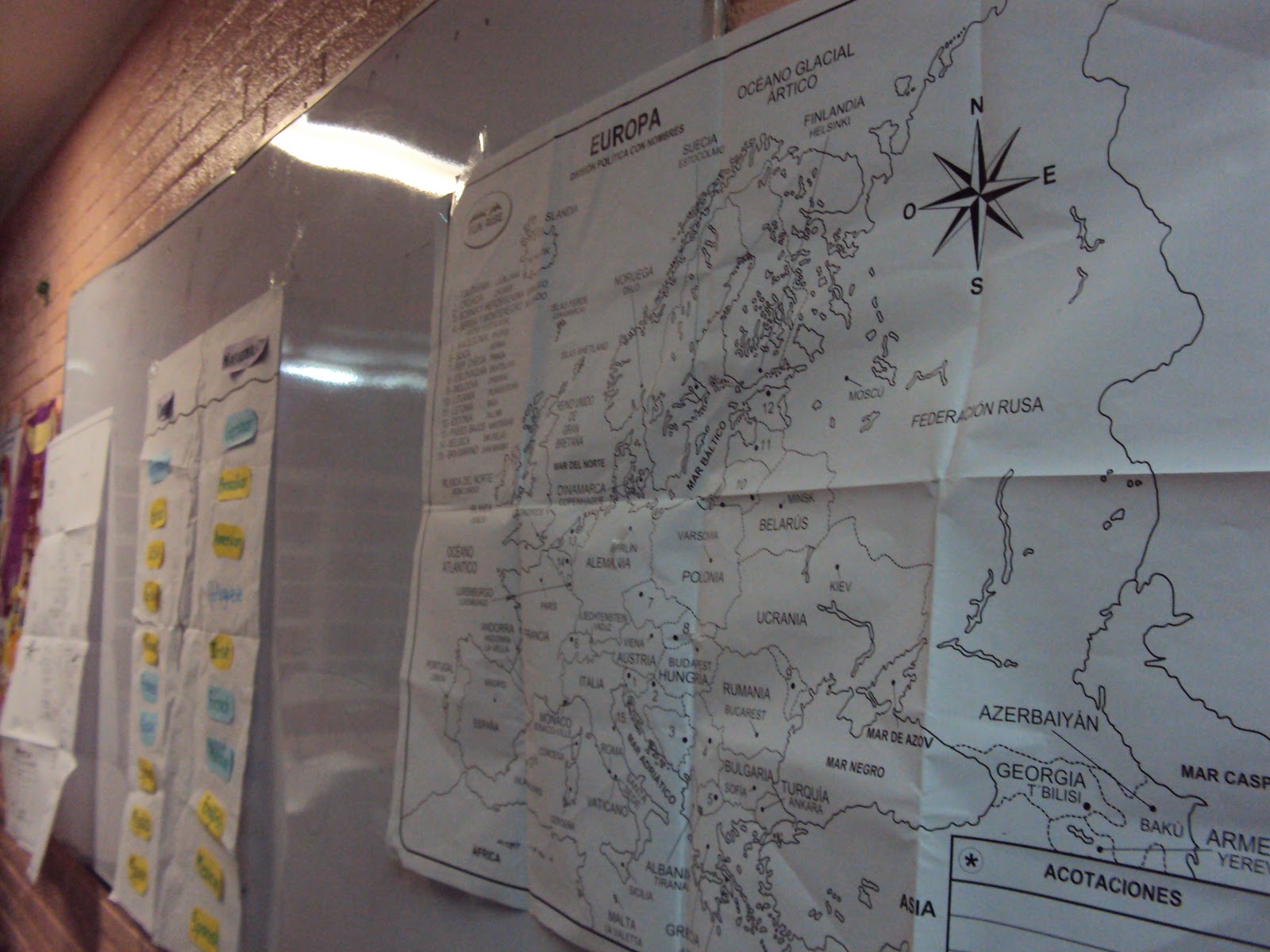

I showed the picture of a famous person and they would tell me where that person came from and the nationality he/she had, also, they repeated the pronunciation of the country and the nationality demanded at that moment. A student came to the board and sticked the picture in in the map


 Students being evaluated.
PRACTICE REPORT: COUNTRIES AND NATIONALITIES.
REPORT
PRACTICE 1
The English class was given on October 27th 2010 in the 1st grade group “A” in the school Secundaria Federal No. 1 Presidente Cárdenas during the afternoon turn. The correspondent class was about “Nationalities and countries” and the objective was students to be able to talk about some countries and nationalities in English by the end of the lesson.
Pre-listening :
Objective: To generate previous ideas about the topic
Based on previous knowledge of students through a brainstorming in which they presented some names about countries they already knew in English and Spanish such as China, Spain, Mexico, Germany and so forth; also they mentioned some nationalities like: Mexican, French and Japanese. This activity was really useful for me in order to identify how much they know about the topic and also it contributed to the development of the class.
Main Activity “My English Class”
Objective: To introduce students to the topic using a text for developing the activity.
The main activity was initially through a descriptive text that was related to different nationalities and physical description of the characters. The title was “My English class” and it was composed by big attractive images in a power point presentation. This activity was focused in order to active the listening of students with the purpose they could notice about the pronunciation and consequently inferred the functions of the sentences.
After that, I presented the activity entitled “Famous people and nationalities” that consisted on presenting an European and American map. As first step, I used an image of a famous person and asked: “Who is he/she?”. Then I showed it to the students in order they tell me who he/she was –in English or Spanish- and then I asked them: “Where is he/she from?” and they tried to tell me where he/she was from according to what they knew. E.g., the first picture I showed was Milla Jovovich, so they gave me the name and the country she was from, with this I could start asking questions and the way to anwer them, it means: “Where is she from?” “She is from Russia; she is Russian”. Students repeated this information with every picture I showed.
Finally, I showed the picture only and pointed out the country in the maps and they answered in chorus according to the person (he, she o they), the country or the nationality demanded.
Evaluation
The activity for evaluation consisted in giving to each student a small card in which in one side had the flag of a country –already seen- and in the other side some physical characteristics of the people who lived there. This activity was designed to work in pairs in order students to interact and share the information given using those small cards. However, because of the time I had to change the activity. I was showing the cards in front and I gave the participation to the student. In this way, I could take advantage of the time and I got majority of students were evaluated. Likewise, I could do all students got involved in the class, it is, everybody answered in chorus without giving specific participation.
I consider in this class students were willing to participate and interact with their partners.


Suscribirse a:
Entradas (Atom)