miércoles, 12 de enero de 2011

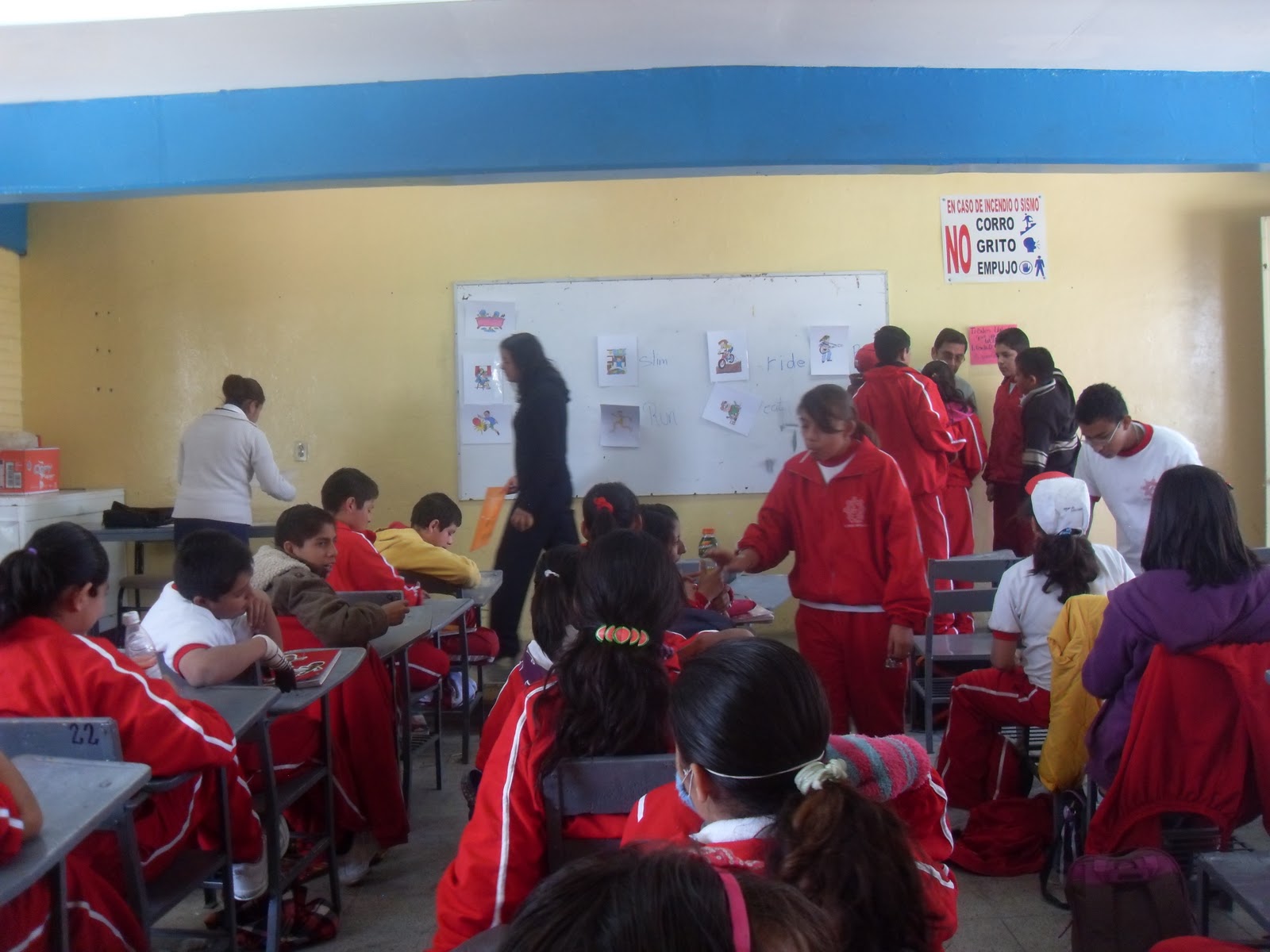
Photos second practice: First grade

Topic: Review of simple present tense.


 Introduction myself and telling students the objective of the class

 Brainstorming          
                      
Students wrote the verbs they already knew


Taking notes when the teacher asked them
Students first listened and reapeated
Students notice  the spelling of the verbs

Students participated actively

 Evaluation

Report of second practice: First grade.

TOPIC: Review of the simple present tense.

*Brainstorming

The class started with a brainstorming of students, in that moment, they participated spontaneously and really good because they had already learned the common verbs. So, I asked some students to come to the board and write any verb they remembered, some examples were:

Play
Dance
Eat
Run
Drink
Read

*Pre-listening

Then, I presented a little text in which there were more verbs in a small description. I started reading it and pronounced it. When I finished I asked students to repeat after me the new verbs.Eg.:  Peter sleeps. "Sleep" (and I showed the image)

*Practice

After this activity, I showed the flashcards with the verbs, I sticked and wrote them in the board and they pronounced them.
The teacher asked students to write the new words in their notebooks. Then I asked students to write a sentence per verb.

*Evaluation

Finally I asked students to come to the board again and to write the name of the verb according to the picture and write a sentence.


PERSONAL COMMENT: This class was good because as students already know the structure of the simple present they participated in a better way and spontaneously, even some of them wanted to pass to the board more than once.  And students also drew the new verbs they had gotten.


OBSERVATIONS BY THE TEACHER: The teacher told me everything was good, however, he asked me to say the instructions completely in English and if students did not understand them I can translated to Spanish, but after saying them in English.

Lesson plan for first grade from December 13th to 17th 2010.

Topic: Review of present simple tense

Oficio Escuela Secundaria Técnica No. 43

martes, 11 de enero de 2011

Acquisition and learning of a language

Today and accordimg to the material given I can resume the main differences between acquire and learn a language:

                  spontaneous
Acquisition:  unconscious
                    without reflection


                controlled
Learning: intentional
               conscious   
               with a purpose
               planned
               is part of an evaluation  
               reflexive

Contributions of Piaget´s theory to the education field

Nowadays Piaget's theory is a base for the changes made in education:

1.- He proposed "learn to learn" must be the goal of education because in this way students become in creative, independant and conscious people instead of simple tansmission and memorization of information.

2.- Piaget established that knowledge is constructed from physical and mental activities of the child:
      To know an object is use it. Know it is modify it, transform it, understand
       the proccess of that transformation and consequently, undestand the way it is contructed (p.8)
According to this,children need the opportunity to explore, experiment, look for answers to their questions but using the mental activity.

3.- Piaget pointed out activities must be adjusted according to the conceptual development stage of the child.    Learning  is better when the activities are related to things the child already know, but at the same time, it overcomes the current comprehension level in order to provoke a congnoscitive conflict.

4.- Social interaction plays an important role in the cognoscitive development to rhe child.  Sociual interaction helps to reduce the egocentrism of young children.

Approaches to teaching foreign languages

Today in the class of OPD the teacher gave us some copies about studies in the field of Teaching Foreign Languages (Piaget) , and this was what I found:
Assimilation: It involves the interpretation of events in terms of existing cognitive structure. In other words, it is to use a response already learned in order to react to a new stimulo.  

Accomodation: Is the changing of the cognitive structure to make sense of the environment. In other words, it is to internalize a stimulo that does not fit in any structure we already have.


During my practice I could find this concepts like this:

Assimilation: When students repeated after me after I pronounced and pointed out the country in the map, they do it in a mechanic way (repetition and memorization). Then. they assimilated the answers to respond to the question withouth using the repetition/memorization.


Accomodation: At the moment students could distinguish some words, their function (verb, noun,etc) and the order of those elements,  they accomodated that knowledge...


Finally I could notice that as secondary students are in the Formal operations stage (from 12-15 years) they involve abstractions, it means, they are more conscious and they understand what they do. And it is important to consider what Chomsky says: "Context is crucial when learning a second language", so we as teacher must create that context in the classroom.